
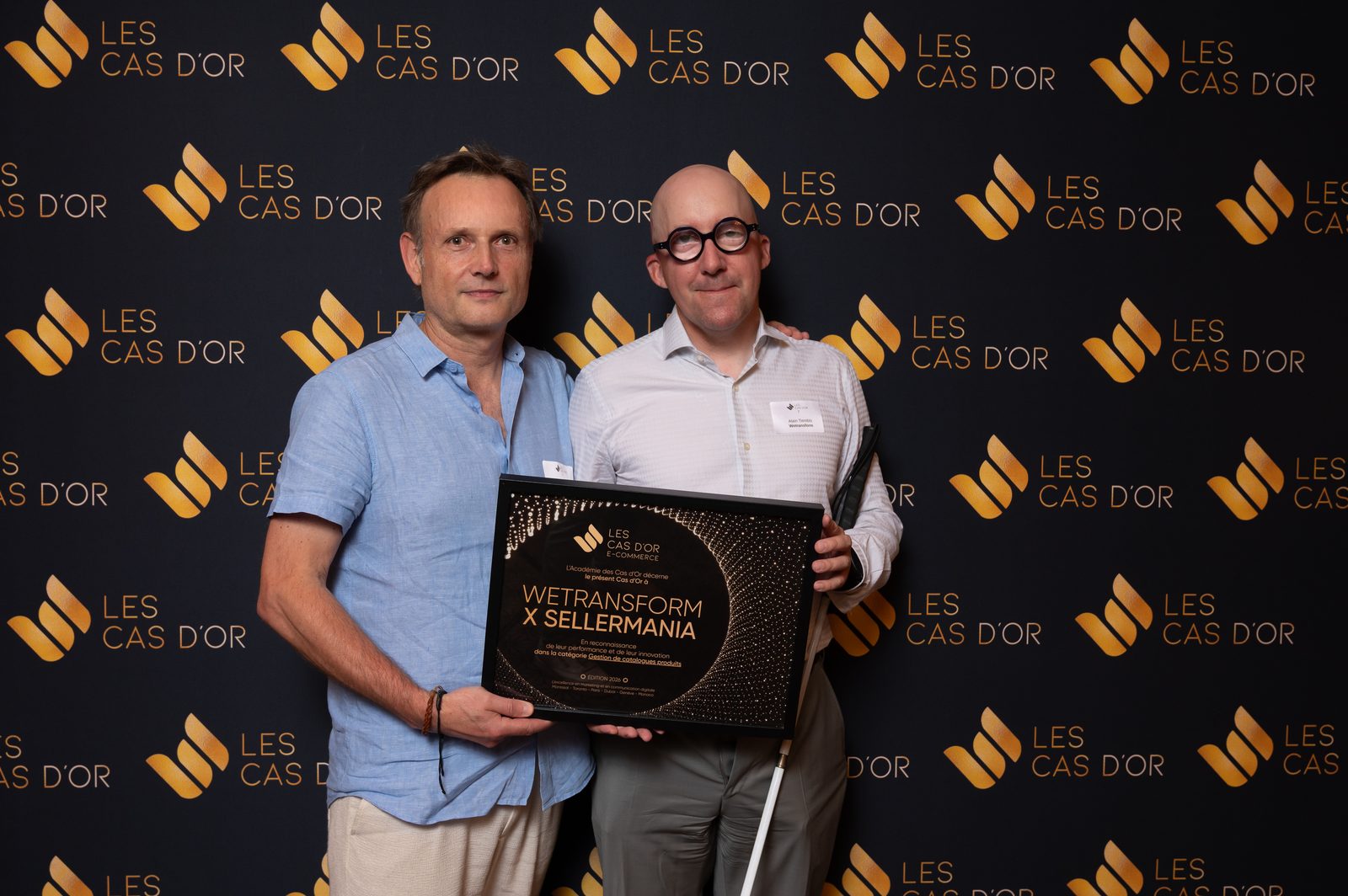
We are proud of this one. 🏆
WeTransform and Sellermania won the Cas d'Or du Digital 2026, Product Catalog Management category. Three years of work recognized. Here is the story.
From an internal experiment to the Cas d'Or du Digital 2026
Three years ago, WeTransform was an idea. One question: what if we ended the product mapping nightmare on marketplaces?
Before pitching to anyone, we tested it internally. Sellermania had exactly the problem WeTransform was built to solve: thousands of merchants sending product data in their own format, across hundreds of marketplaces with different requirements each.
We integrated WeTransform directly into Sellermania, before it had a single external customer. The requirements were real. The merchants were real. The support tickets were real.
The award did not come first. The work did.
The catalog problem every marketplace has normalized
Merchants send product data in their own format. Excel. CSV. Proprietary exports from systems built twenty years ago. Different column names. Different category logic. Different everything.
Each target marketplace adds its own requirements: different schemas, different taxonomies, different validation rules.
This is format multiplication. It grows with every merchant and every marketplace added. It is structural, not accidental.
Most platforms absorb it silently: support teams reformat files, engineers write custom scripts, some merchants give up before their first import. The cost shows up as slow onboarding and engineering time that creates no product value.
The problem had been normalized. It was the cost of doing business.

What Sellermania's data looked like before WeTransform
A new merchant would upload their catalog. The format would not match. Support would clean it manually, or send a template and wait days for the correction. Engineers wrote custom scripts for the hardest cases, each one adding permanent maintenance debt.
Some merchants abandoned before their first import was complete. The onboarding step that should have been a win was a friction point instead.
The Sellermania case study documents the full before-and-after.
Two demos: the technology in action
The two capabilities that made the biggest difference at Sellermania. Try them directly, no sign-up needed.
Fill the Gaps: upload a product sheet with incomplete attributes. The AI fills what is missing from the data that already exists.
AI category mapping: see how WeTransform maps categories from any source taxonomy to a target marketplace schema.
How WeTransform's AI handles it
The integration: embed WeTransform's white-label importer into Sellermania. Merchants see a Sellermania-branded interface. WeTransform handles everything behind it.
When a merchant uploads their catalog, three things happen automatically:
- AI column mapping detects source-to-target field correspondences. "Prix HT" becomes "price_excl_tax". The merchant validates in one click, no manual mapping needed.
- AI category mapping handles taxonomy differences across 120+ marketplace templates. "Jardinage" becomes "Outdoor > Garden > Tools" on Amazon, "Garden & Outdoors" on eBay, automatically.
- Fill the Gaps completes missing attributes. If a product description exists but size, weight, and material are absent, the AI infers them and fills them in.
Result: merchant uploads their existing file. Sellermania receives clean, normalized data. No back-and-forth.
The full setup ran on WeTransform's JavaScript SDK with HMAC authentication. It took two weeks, for a platform serving 150 active merchants across 120+ marketplaces.
This is what AI import management looks like in production.
The results: 90%, 50%, 36 million products
90% reduction in catalog onboarding time. Days become minutes.
50% fewer import-related support tickets. The team moved from file cleanup to actual expertise.
36 million products transformed: mapped, categorized, validated, delivered clean.
Sylvain Mançois, Product Owner at Sellermania Software: "The AI-assisted mapping has been a game changer. It lets our customers configure their feeds quickly and transform them into our internal format, without back-and-forth."
"Without back-and-forth." That is the metric that matters.

This is not just a marketplace problem
The Sellermania case is one instance of a pattern that appears across B2B SaaS. Any platform receiving files from external parties faces format multiplication.
Logistics manifests from carriers. Supplier catalogs in procurement. Client account exports in fintech. The specifics change. The problem does not.
Most teams solve it by building parsers internally. Each new format needs new code. Maintenance compounds. Why not build it internally has a clear answer: ongoing maintenance almost always costs more than embedding a dedicated importer.
WeTransform is that layer. An embedded data importer that handles any format your customers or partners send, maps it to your schema, and delivers clean data to your system.
The Cas d'Or validated what we built with Sellermania. The same thing applies to every platform that has accepted format multiplication as the cost of growth. It should not be.
Book a 20-minute demo to see what it looks like in your product.